All-new Mitsubishi Pajero revealed: 5 things Malaysia needs to know
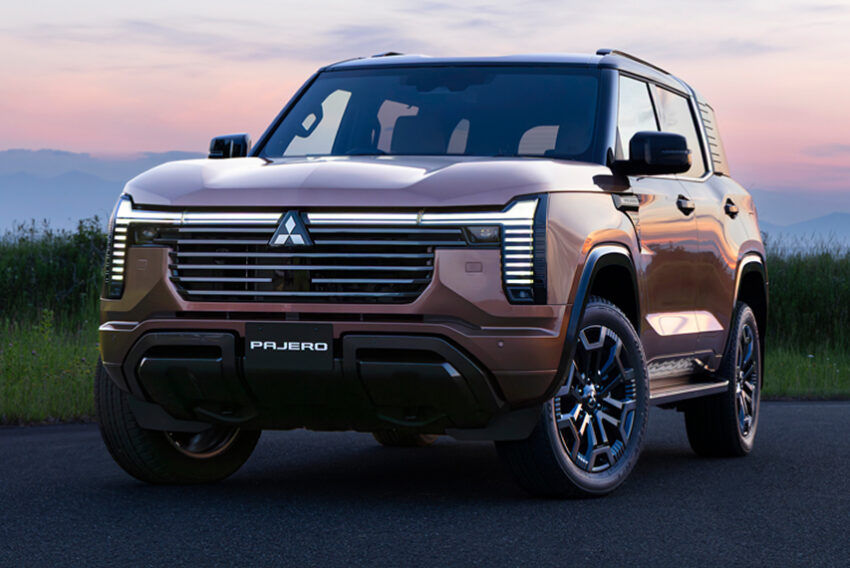
KUALA LUMPUR: The Pajero name has been sitting in a drawer since 2021. Mitsubishi pulled it globally, left the Pajero Sport to carry the flag in Southeast Asia, and for five years there was nothing.
KEY TAKEAWAYS
Is the new Mitsubishi Pajero coming to Malaysia?
Not yet confirmed. Mitsubishi is launching the Pajero in Thailand first, followed by Japan and Australia during fiscal 2026, which ends in March 2027. From fiscal 2027 the company says it plans to sell the model in roughly 100 countries including ASEAN markets, which puts Malaysia in the second wave at the earliest. Mitsubishi Motors Malaysia has not made any announcement about putting it on sale in Malaysia.What engine does the new Mitsubishi Pajero use?
A 2.4-litre 4N16 clean diesel adapted from the Triton, running a single variable geometry turbocharger instead of the pickup's twin-turbo setup. Outputs are 150kW (204 PS) and 480Nm, matched to a newly developed eight-speed automatic. Mitsubishi has confirmed some overseas markets will get 470Nm instead, so the Malaysian figure is not settled.Is the new Pajero based on the Mitsubishi Triton?
Partly. The front section of the ladder frame, including the front of the floor, carries over from the Triton. The rest has been reworked with additional cross-members and larger side members, and the wheelbase is 250mm shorter than the pickup's. Suspension is double wishbone front and a live rear axle with coil springs at all four corners.On 2 September, the company put a fifth-generation Pajero on a stage in Tokyo and called it the flagship for the entire brand.
For a nameplate with 12 Dakar wins behind it, including seven straight, that is a heavy thing to say. Here is what actually sits underneath the claim, and what it means for Malaysian buyers.
Also Read: Mitsubishi Triton Single Cab AT launched in Malaysia at RM107,980
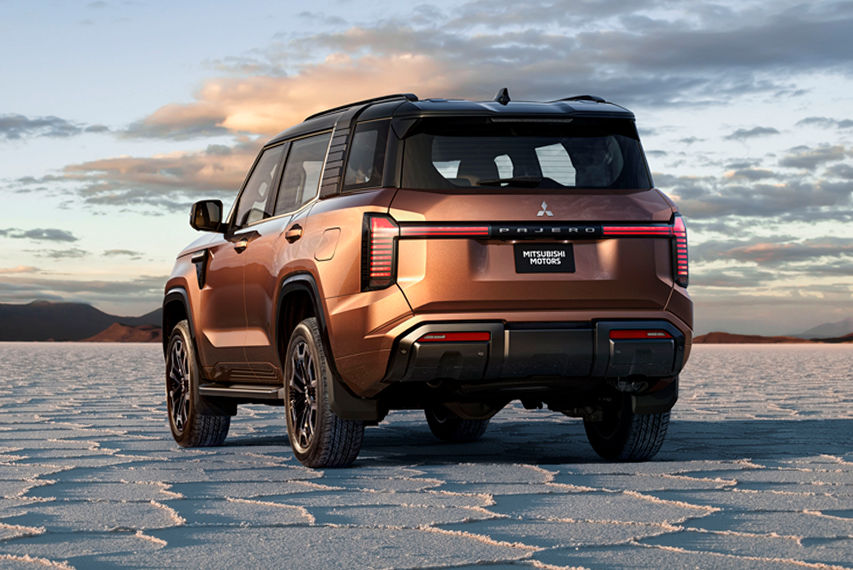 Photo from Mitsubishi
1. The ladder frame is back, and only part of it is the Triton's
The old fourth-generation car used a monocoque with a built-in frame, a clever bit of engineering that never fully convinced the hardcore off-road crowd. The new one drops the compromise and returns to a separate ladder frame.
It is not a straight Triton lift, though. The front section of the frame, including the front of the floor, carries over from the pickup. Everything behind that has been reworked with additional cross-members and larger side members. Mitsubishi says expanded use of high-tensile steel cuts the weight of applicable components by half, and the bonnet is aluminium.
Suspension is double wishbone up front with a live rear axle, coil springs at all four corners, and disc brakes all round. The wheelbase is 250mm shorter than the Triton's, which matters more than it sounds for anything tighter than a fire road.
The numbers: 4,920mm long, 1,925mm wide, 1,910mm tall, on a 2,870mm wheelbase with 1,630mm tracks front and rear. Ground clearance is 230mm, approach angle 30.4 degrees, breakover 22.6 degrees, departure 25.8 degrees, with a 52:48 front-rear weight split and an 11.6-metre turning circle. That is proper hardware, not a styling exercise with plastic cladding.
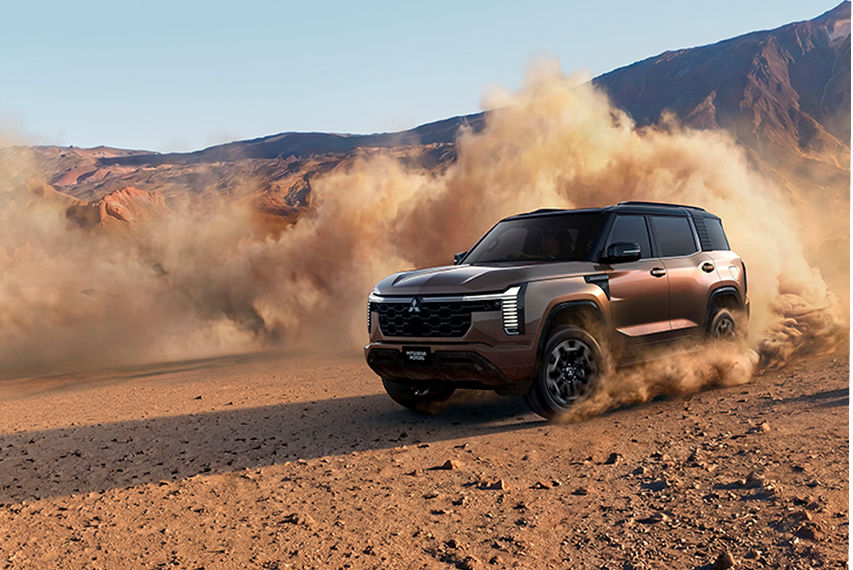 Photo from Mitsubishi
2. One engine, 150kW, 480Nm
Power comes from a 2.4-litre clean diesel, the 4N16, adapted from the Triton but running a single variable geometry turbocharger instead of the ute's twin-turbo setup. Mitsubishi claims better response despite losing a turbo. Outputs are 150kW (204 PS) and 480Nm, paired to a newly developed eight-speed automatic with sport mode, up from six speeds in the Triton.
Read the small print, though. Mitsubishi has already confirmed some overseas markets will get 150kW and 470Nm instead, which is exactly the Triton twin-turbo's figure. Whether Malaysia lands on 480 or 470 is a genuine open question, not a rounding error, and it is worth pinning down before anyone starts making comparisons on paper.
There is no V6 in the plan at all. Hybrid and plug-in hybrid versions are being studied to join the range later, but neither is confirmed and neither was part of this reveal.
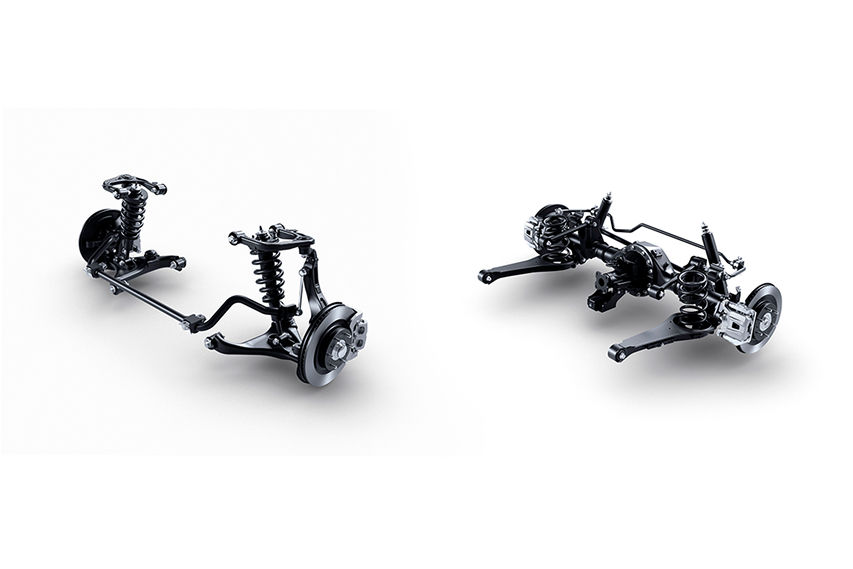 Photo from Mitsubishi
3. SS4-II, S-AWC and a rear diff lock
Super Select 4WD-II gives four modes: 2H, 4H, 4HLc with the centre differential locked, and 4LLc adding low range. Layered over that is S-AWC, which varies torque front to rear, while Active Yaw Control splits it left to right. There is also a rear differential lock, as on the Triton.
Seven drive modes are offered: Normal, Eco, Gravel, Snow, Mud, Sand and Rock. Braking is handled by what Mitsubishi describes as large 18-inch rotors with an electric booster.
The genuinely useful feature for anyone driving Malaysian back roads is the 3D Multi Around Monitor's front under-floor view, which shows the ground beneath and just ahead of the car. It appears automatically when you select 4HLc or 4LLc, or you can call it up manually.
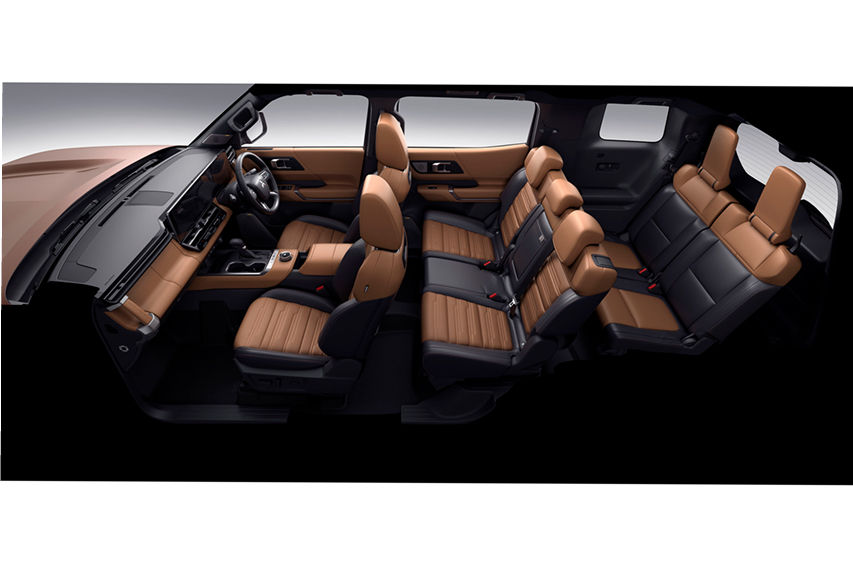 Photo from Mitsubishi
4. Seven seats, and the screens depend on what you pay
Three rows, seven seats, and a cabin Mitsubishi keeps describing with the word "prestige". Just be clear on what you actually get. Entry variants run twin 12.3-inch displays. Only flagship versions get the 14.3-inch pair, with the revived Multi Meter reworking the old triple-gauge cluster into a digital readout for altitude, compass heading, temperature, pitch and roll angles, and AYC status.
Encouragingly, Mitsubishi has resisted burying everything in the touchscreen. There is still a volume dial, roller dials for air temperature and fan speed, a conventional gear lever, and a rotary controller for drive modes and four-wheel-drive settings.
Second-row passengers get side-door sunshades, heated outboard seats, a dedicated climate zone, a household power outlet and two USB-C ports. Grab handles are built into the rear door trim to help people climb into the third row, and the bench slides through 150mm and tumbles.
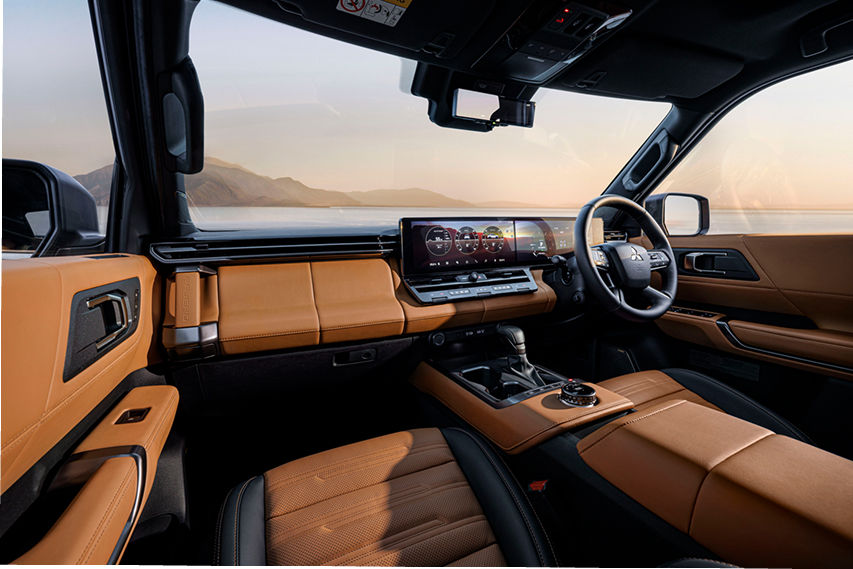 Photo from Mitsubishi
Acoustic glass covers the windscreen and both sets of door windows, there is seat ventilation and three-zone climate control, and a 12-speaker Yamaha system with noise compensation tied to vehicle speed. Panoramic sunroof and two-tone black and tan leather sit on the options list.
Outside, top models get full-width LED lighting front and rear with scrolling animations on lock and unlock. The main beams are mounted inboard of the daytime-running lights specifically so trail scrub does not take them out, which tells you something about who Mitsubishi thinks is buying this.
High-grade variants ride on 20-inch alloys in two finishes. The spare has moved underneath the car, which is what allows the top-hinged tailgate.
Design references run deep. The C-pillar nods to the 1982 original's roll bar, and a hexagonal crease in the tailgate stands in for the old rear-mounted spare. Two grille designs are offered, horizontal bar or honeycomb, under T-shaped headlights, and the windscreen pillars are more upright than the Triton's.
On safety, eight airbags including Mitsubishi's first SRS centre airbag, plus Emergency Lane Assist making its brand debut, FCM with pedestrian, cyclist and motorcyclist detection and junction assist, PFCW, EAPM, front cross traffic alert, and MI-PILOT for highways.
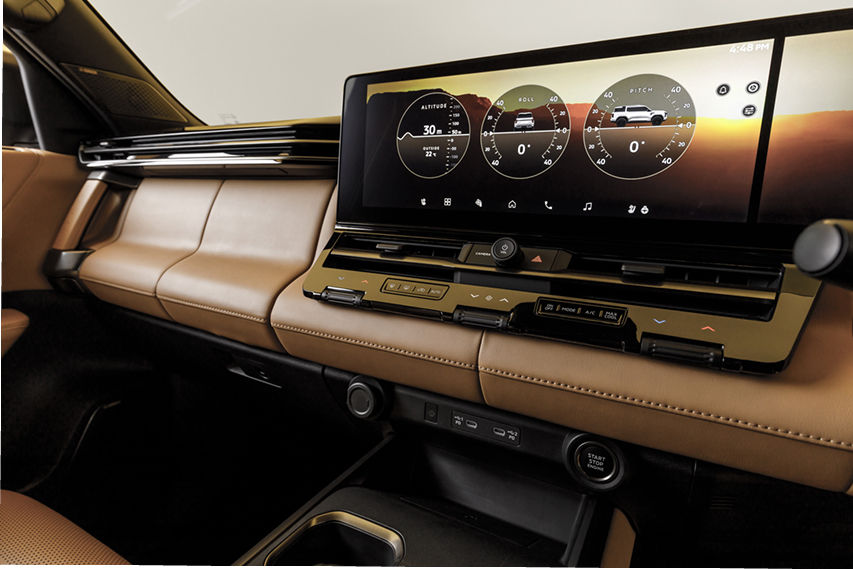 Photo from Mitsubishi
5. Malaysia is not on the first list
Production is in Thailand. Thailand gets it first, followed by Japan and Australia during fiscal 2026, which runs to March 2027. From fiscal 2027 onward, Mitsubishi says it plans to roll the car out to roughly 100 countries, ASEAN included.
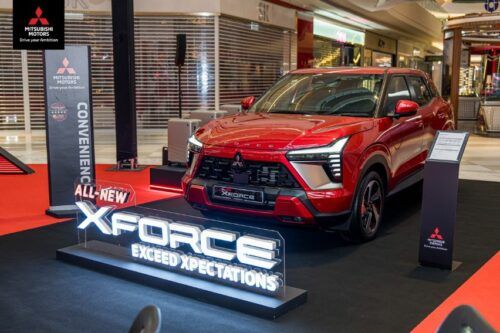
That puts Malaysia in the second wave at the earliest, and Mitsubishi Motors Malaysia has not committed to anything. The local range is currently just three models, Triton, Xpander and Xforce, with no ladder-frame SUV in it at all.
The case for bringing this one in more or less writes itself. Note too that the Pajero Sport stays on sale in some overseas markets alongside the new car, so this is not automatically a replacement everywhere.
Price is the harder question, and there is now a decent clue. Mitsubishi benchmarked the new Pajero against the Toyota Land Cruiser Prado and the LandCruiser 300 Series, plus SUVs from luxury brands. That is not the company of a mid-table product.
The car is real, the hardware reads right, and it is being built a short drive up the peninsula. Whether Mitsubishi Malaysia can make the numbers work is the part nobody can answer.
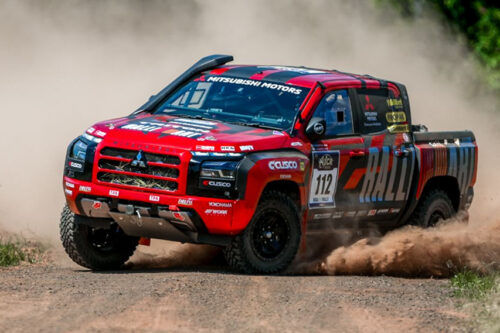
Also Read: Mitsubishi Ralliart triumphs at AXCR 2026; second consecutive win

Mitsubishi Car Models
-

Mitsubishi Xpander -
Mitsubishi Triton -
Mitsubishi XForce
KLIMS 2026


Malaysia Autoshow
Trending & Fresh Updates
- Latest
- Popular
-

-
-
-
-
-
-
-
-
-
Electric Car: A comprehensive buying guidePurva Jain, Jul 01, 2024
-
Must watch automotive movies for enthusiastsPurva Jain, Feb 21, 2024
-
Car Rust-proofing 101: All you need to knowPurva Jain, Feb 15, 2024





You might also be interested in
- News
- Featured Stories
-
-
-
-
-
Top 10 best-selling EVs in Malaysia for 2025Sippi Vig, Dec 26, 2025
-



Mitsubishi Featured Cars
- Latest
- Popular
-
 Mitsubishi TritonRM 101,980 - 159,980 OTR Price Kuala LumpurEMI : RM 1,191 x 844.19 (52 Reviews) VIEW SEPTEMBER OFFERS
 -
Mitsubishi XForceRM 109,980 - 119,980 OTR Price Kuala LumpurEMI : RM 1,285 x 84Write a Review VIEW SEPTEMBER OFFERS
-
Mitsubishi XpanderRM 99,980 - 109,980 OTR Price Kuala LumpurEMI : RM 1,168 x 844.18 (44 Reviews) VIEW SEPTEMBER OFFERS
-
Mitsubishi TritonRM 101,980 - 159,980 OTR Price Kuala LumpurEMI : RM 1,191 x 844.19 (52 Reviews) VIEW SEPTEMBER OFFERS
-
Mitsubishi XForceRM 109,980 - 119,980 OTR Price Kuala LumpurEMI : RM 1,285 x 84Write a Review VIEW SEPTEMBER OFFERS
Latest Mitsubishi Car Videos on Zigwheels

-
Mitsubishi Xforce First Impressions Malaysia – Is This the Surprise SUV of 2026?24 Mar, 2026 .
-
2024 Mitsubishi Xpander Facelift is here! Starting from RM99,98023 Sep, 2024 .
-
2022 Mitsubishi Mirage G4 GLS Review | Zigwheels.Ph13 Sep, 2021 .