
Ferrari Luce: everything you need to know about the first fully electric Ferrari
- KEY TAKEAWAYS
- What is the Ferrari Luce?
- Who designed it?
- What does it look like?
- Five seats, four doors, and no central tunnel
- What's the tech inside?
- Performance figures and powertrain
- How does the all-wheel drive and torque vectoring work?
- The sound: real, not synthesised
- Aerodynamics and drag
- Chassis and structure
- Sustainability and materials
- Ownership and after-sales
KUALA LUMPUR: Ferrari just pulled the covers off the Luce, its first proper production electric car, at Rome's Vela di Calatrava sports complex. The date wasn't picked at random.
KEY TAKEAWAYS
What is the Ferrari Luce?
The Ferrari Luce is the brand's first fully electric production car. It's a four-door, five-seat performance grand tourer built on a completely new bespoke platform developed entirely in Maranello.How fast is the Ferrari Luce?
The Luce does 0-100 km/h in 2.5 seconds and 0-200 km/h in 6.8 seconds, with a top speed of 310 km/h. Maximum power output in Launch Control mode is 772 kW or 1,050 cv.What is the Ferrari Luce's range?
Ferrari estimates a range of over 530 km on a single charge, though this figure is still going through WLTP homologation.On this day in 1947, Franco Cortese drove a Ferrari 125 S to victory at the Gran Premio di Roma at the Baths of Caracalla circuit, which is technically where the whole Ferrari legend kicked off. Seventy-nine years later, Maranello comes back to Rome with something very different.
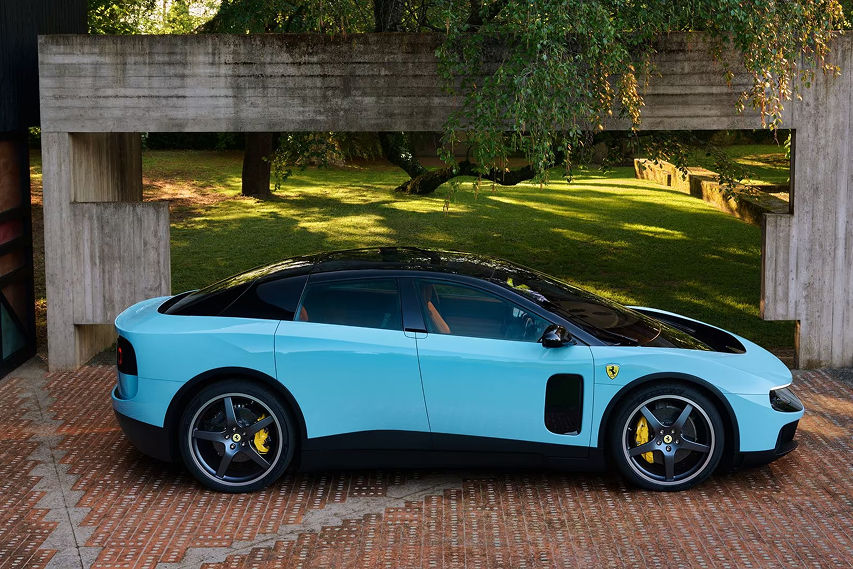 Photo from Ferrari
What is the Ferrari Luce?
The Luce (which means "light" in Italian) is Ferrari's answer to the all-electric performance car segment. It's a four-door, five-seat grand tourer built on a completely bespoke electric platform, and nothing about it carries over from a previous Ferrari model. The chassis, battery, electric motors, suspension, and even the sound system were all developed from scratch in Maranello.
Ferrari has been clear that this doesn't replace combustion engines in its lineup. The company has been talking about "technological neutrality" since its 2022 Capital Markets Day, basically meaning it wants to offer fully electric, hybrid, and combustion-powered cars at the same time. The Luce just adds another option.
As Ferrari CEO Benedetto Vigna put it:
"We are the first in the world to combine fully electric, hybrid and combustion engine architectures for sports cars. We have created a car that combines unique driving emotions with extraordinary performance, driving pleasure, and comfort for the Ferraristi of today and tomorrow."
Who designed it?
Here's where things get interesting. Ferrari didn't hand this one to its in-house design team led by Flavio Manzoni. Instead, it brought in LoveFrom, the creative collective founded by Jony Ive (yes, the guy who designed the iPhone) and Marc Newson in 2019. The studio is based in San Francisco and London and already works with OpenAI, so Ferrari is clearly in good company.
The idea was to get an outside perspective, which makes sense when you're building something this different from anything Ferrari has done before.
Ferrari president John Elkann said:
"Such a leap forward in product innovation could only have been achieved through process innovation; this is why we chose to embark on new collaborations, such as the one with LoveFrom for the design. Rome, the symbolic location of our first victory, becomes the starting point for a Ferrari that lights up the future and opens new horizons."
Photo from Ferrari
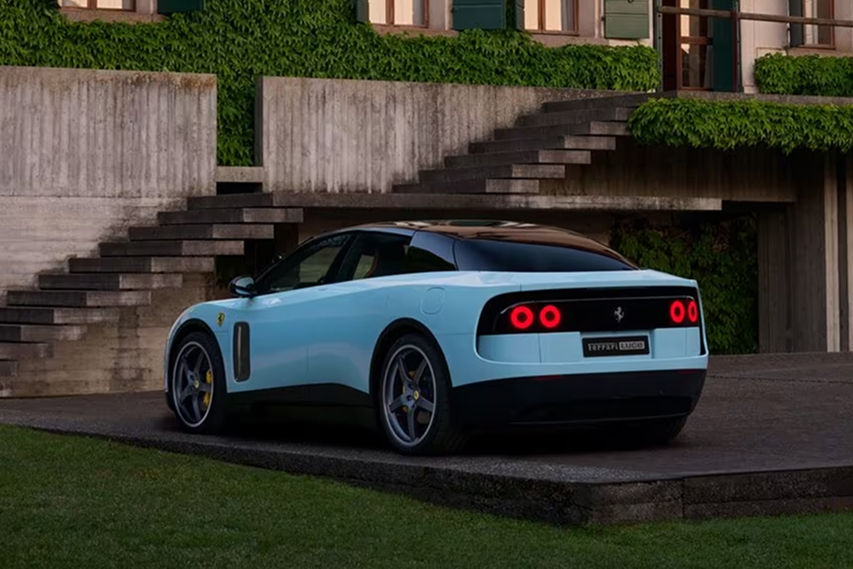 Photo from Ferrari
What does it look like?
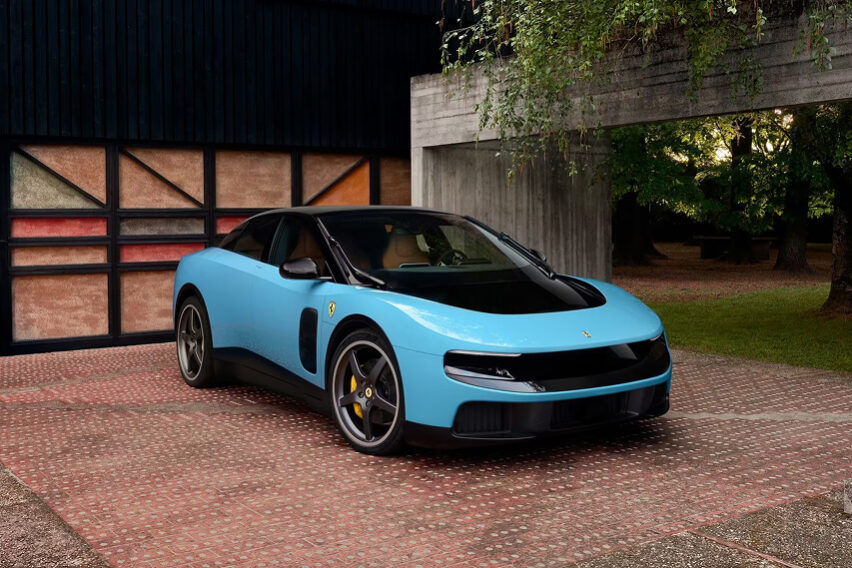
The design language is built around one core idea: simplicity. No creases, no sharp edges, no aggressive vents. The glasshouse is the dominant visual element, and it extends below the beltline in a way that's deliberately unusual for a car of this type.
Front and rear aerodynamic wings sit above and around the glass structure, giving the car a floating appearance. The light panels front and rear are transparent and integrated directly into the primary bodywork surfaces. When the lights are off, they recede into the shape of the car rather than sitting on top of it. The tail lights take visual cues from the 360 Modena and 458 Italia.
One detail that'll get attention is the wheel sizing. The Luce runs 23-inch rims at the front and 24-inch rims at the rear, which makes it the most dramatically staggered wheel setup on any production Ferrari road car to date. Two wheel designs are available: an open five-spoke forged option and a turbine-style aerodynamic design.
Launch colours are Azzurro la Plata, Giallo Luce, Rosso Dino, Bianco Artico, and Rosso Fiammante. The yellow was specifically developed from the historic yellow in the Ferrari logo.
Five seats, four doors, and no central tunnel
The Luce is only the second four-door Ferrari ever made, and the first with five seats. Why could Ferrari finally fit five people? Because there's no traditional transaxle setup here. The flat battery pack lives under the floor, which eliminates the central tunnel entirely and frees up interior space. The front and rear seats now have room to breathe in a way that previous Ferrari layouts wouldn't allow.
Ferrari says the interior feels larger than the exterior suggests. The design approach treats each individual control and surface as its own considered product rather than part of a generic cockpit. The goal was to reduce clutter and get everything down to the most essential elements.
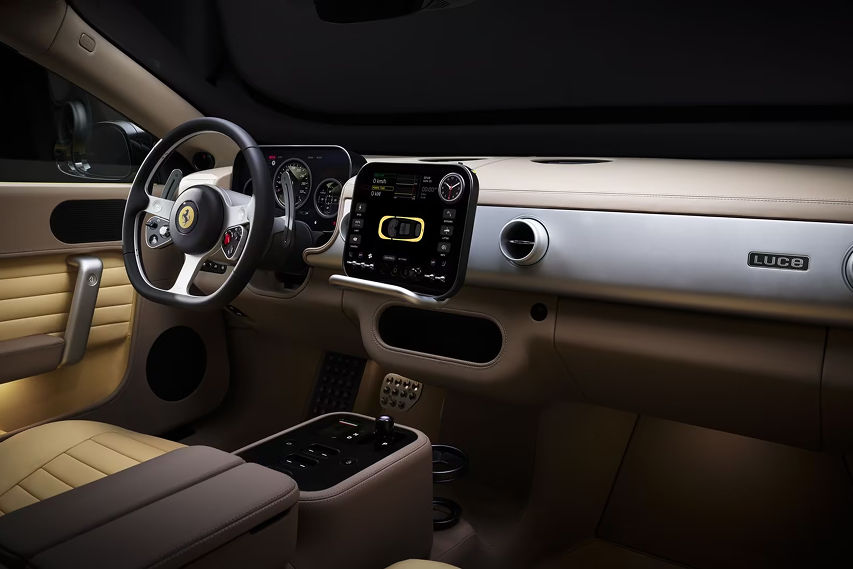 Photo from Ferrari
What's the tech inside?
The cabin runs four Samsung Display OLED screens: a 12.9-inch binnacle display, a 12-inch and 10.1-inch for the central control panel area, and a 6.3-inch rear panel. The binnacle is particularly interesting because it uses a multi-layer design, with two panels stacked on top of each other and cutouts in the upper layer to create depth. The result is meant to feel more analogue than a flat screen.
The three-spoke steering wheel is machined from 100% recycled aluminium. The Manettino is still there in its classic five-position form, now joined by a three-position e-Manettino that handles power delivery, torque curve, traction type, and performance ceiling.
One world-first worth mentioning: the ignition key is made from Corning Gorilla Glass and features an E Ink display. E Ink only uses power when it changes state, not while it's displaying something, which makes it extremely efficient.
Ferrari says this is the first automotive glass key with that technology. When the key docks into the console, a flash of Ferrari yellow sweeps across the interface before the car starts.
The audio system runs 21 speakers with 24-channel, 3,000-watt amplification. Five presets are available: Studio, Concerto, Immersive, Opera, and Electronic, plus a Solo mode.
Performance figures and powertrain
The Luce runs four permanent magnet synchronous motors, one per wheel. The front axle produces 210 kW, the rear produces 620 kW, for a combined maximum output of 772 kW or 1,050 cv in Launch Control mode. Zero to 100 km/h takes 2.5 seconds. Zero to 200 km/h takes 6.8 seconds. Top speed is 310 km/h.
The battery pack is 122 kWh gross capacity, running on 800V architecture. It supports up to 350 kW fast charging, meaning 70 kWh of charge can be added in around 20 minutes. Ferrari also built in a DC/DC booster so the car can pull up to 150 kW from older 400V infrastructure, which is a practical detail that matters in the real world.
Range is estimated at over 530 km, though Ferrari notes that this is still under WLTP homologation.
Each motor in the system reaches between 25,500 rpm (rear) and 30,000 rpm (front), which is genuinely extreme by any benchmark. The motors were developed from the same architecture used in the F80 road car and informed by Ferrari's F1 and World Endurance Championship work.
The kerb weight sits at 2,260 kg. That's heavy, but Ferrari claims the centre of gravity is 95 mm lower than the Purosangue, and the yaw moment of inertia is 15% lower. According to Ferrari's numbers, the Luce handles direction changes as if it weighs about 400 kg less than it actually does.
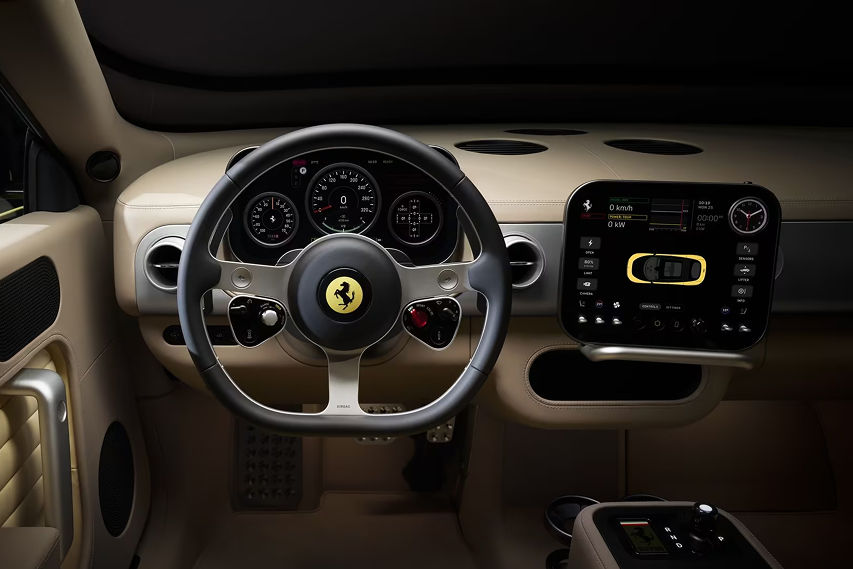 Photo from Ferrari
How does the all-wheel drive and torque vectoring work?
The four-motor setup gives Ferrari complete independent control over each wheel, which isn't something you can achieve with a traditional mechanical diff. Torque Vectoring is split into two systems:
The first is a virtual differential (vDiff) on the rear axle that keeps the car stable and predictable in a straight line by filtering road surface disturbances. The second is Ferrari Lateral Optimisation Wheeltorque (FLOW), which handles corner-in and corner-exit behaviour on both axles, managing understeer and oversteer responses more naturally than conventional systems.
There's also a Torque Shift Engagement system making its debut on the Luce. Using the steering wheel paddles, drivers can select five levels of power delivery with the right paddle and five levels of engine braking with the left. This isn't a gear simulation. Ferrari is explicitly positioning it as a different way to interact with an electric powertrain, giving the driver control over deceleration and acceleration inputs in a way that makes sense at corner entry and exit.
The e-Manettino has three positions: Range, Tour, and Performance.
In Range mode, power is capped at 320 kW, the car runs primarily rear-wheel drive, and top speed is limited to 260 km/h. In Tour mode, power rises to 460 kW, all-wheel drive is always active, and top speed stays at 260 km/h. In Performance mode, full 725 kW is available, all-wheel drive is permanent, and the car hits 310 km/h.
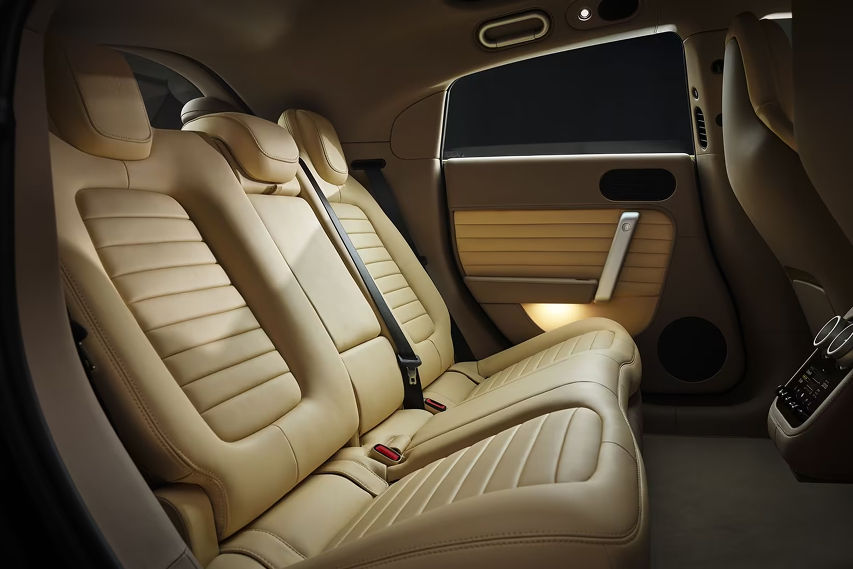 Photo from Ferrari
The sound: real, not synthesised
Ferrari spent five years and covered 40,000 km of dedicated track testing developing the Luce's sound. What they landed on is not synthesised noise. A precision accelerometer mounted in the rear axle housing picks up vibrations from the rotating components in real time. That signal is then filtered, equalised, and amplified in a process Ferrari compares to how an electric guitar pickup works.
The result is sound that changes moment to moment based on what the motors are actually doing, with different content for left and right sides. In Performance mode (Perfo on the e-Manettino), the sound is amplified both inside the cabin and externally. In Range mode, it's completely silent. The idea is that sound becomes functional feedback rather than background noise.
Aerodynamics and drag
Ferrari says the Luce achieves the lowest drag coefficient of any production road car in its history. The aerodynamic development programme took over five years, involved around 6,000 CFD simulations, 250 hours of wind tunnel testing on scale models, and 80 hours with a full-scale car.
Key elements include active grilles that close off the radiators when cooling isn't needed, removing the drag penalty of open vents. The front ride height can drop by 10 mm at speed to improve efficiency. The turbine-style wheels reduce drag by around 5% compared to a conventional wheel design. The flat underfloor from the structural battery pack also contributes significantly.
Chassis and structure
The platform is entirely new and exclusive to the Luce. The chassis combines hollow aluminium castings, extrusions, and sheet metal. Ferrari says the battery housing itself contributes 20% of the chassis bending rigidity and 40% of torsional rigidity. Overall, the structure is 10% lighter than the segment average.
The rear subframe is elastically mounted, which is a first for any Ferrari. It's also a single-piece hollow casting from recycled aluminium and is the largest of its kind Ferrari has ever produced.
The front suspension uses a semi-virtual double wishbone setup that positions the virtual steering axis very close to the wheel centre, which reduces sensitivity to bumps and torque steer. The steering ratio is 13% quicker compared to previous Ferrari applications.
Front brakes are CCM discs measuring 390x34 mm. Rears are 372x34 mm.
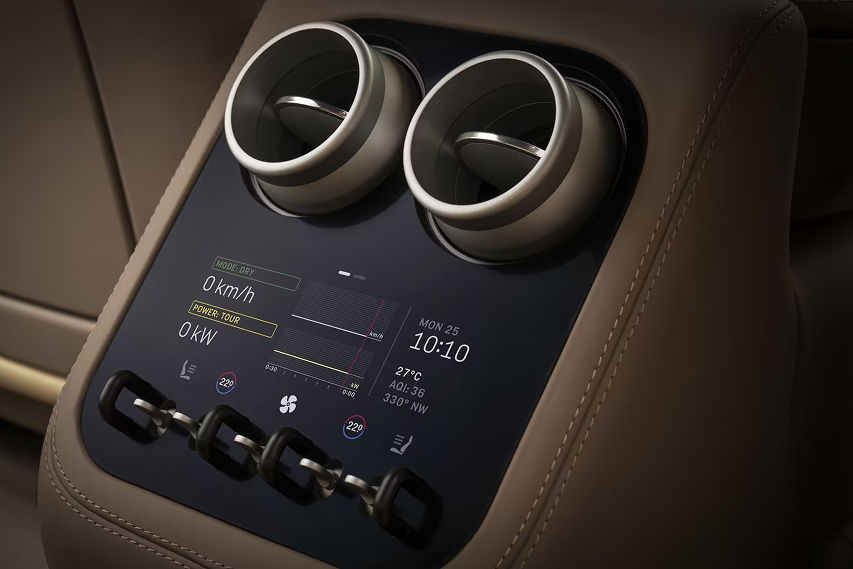 Photo from Ferrari
Sustainability and materials
Roughly 70% of the Luce's overall weight is made from recycled secondary-alloy aluminium, which Ferrari says reduces CO2e emissions in production by around 70% for those components. The steel has been eliminated entirely from the body structure.
The recycled aluminium wheel hub bearings use a third-generation design with low-friction seals that reduce rolling resistance by 50%, which Ferrari estimates adds approximately 9 km of range on their own.
Ownership and after-sales
Ferrari is offering a seven-year routine maintenance programme on the Luce, which covers inspections at 20,000 km intervals or once a year with no mileage cap. The programme uses genuine parts and trained technicians from the Ferrari Training Centre in Maranello.
Electric powertrain components including both axles, the battery, and the charging system are covered by an eight-year dedicated warranty.

Ferrari Car Models
-

Ferrari F8 Tributo -
Ferrari Portofino -
Ferrari 488 GTB -
Ferrari GTC 4Lusso -
Ferrari 488 Spider -
Ferrari Roma -
Ferrari GTC 4Lusso T -
Ferrari 812 Superfast
KLIMS 2026


Malaysia Autoshow
Trending & Fresh Updates
- Latest
- Popular
-

-
-
-
-
-
-
-
-
-
Electric Car: A comprehensive buying guidePurva Jain, Jul 01, 2024
-
Must watch automotive movies for enthusiastsPurva Jain, Feb 21, 2024
-
Car Rust-proofing 101: All you need to knowPurva Jain, Feb 15, 2024


You might also be interested in
- News
- Featured Stories

Ferrari Featured Cars
- Popular