CEER EXOBOT revealed: Saudi EV brand debuts sedan and SUV with up to 1,111 hp
KUALA LUMPUR: CEER is Saudi Arabia’s first homegrown electric vehicle brand, established in 2022 as a joint venture between the country’s Public Investment Fund (PIF) and Taiwanese electronics manufacturer Foxconn.
KEY TAKEAWAYS
What is CEER?
CEER is Saudi Arabia’s first homegrown electric vehicle brand. Established in 2022, it is a joint venture between Saudi Arabia’s Public Investment Fund and Foxconn, with an agreement to license BMW component technology.What is the CEER EXOBOT?
The EXOBOT is CEER’s first flagship vehicle range, offered as a fully electric sedan and SUV. Both use a three-motor, all-wheel-drive powertrain and will be manufactured in Saudi Arabia.Its founding agreement also includes licensing BMW component technology. The aim is to build a local automotive industry as Saudi Arabia broadens its economy beyond oil.
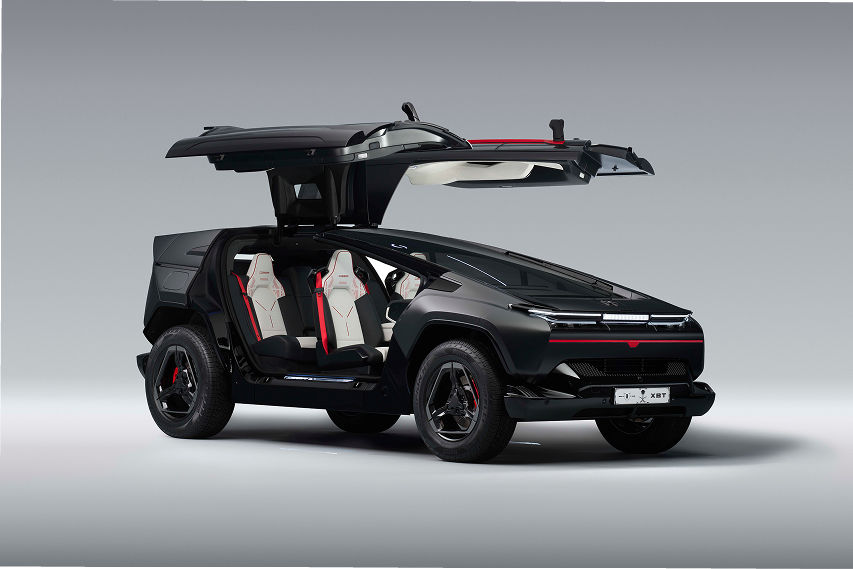 Photo from CEER
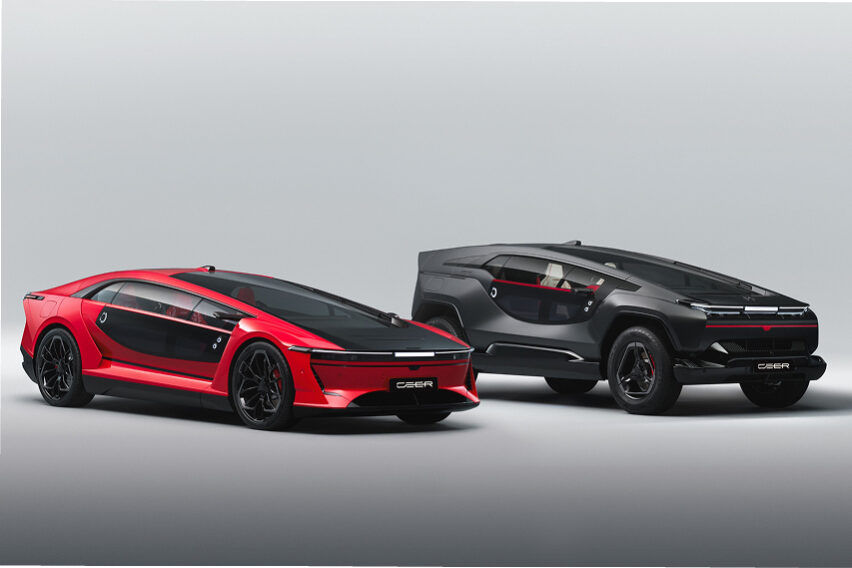
Now, CEER has revealed its first flagship vehicles: the EXOBOT sedan and SUV. Both are fully electric, with three motors, unusually large doors and styling that makes little attempt to blend into traffic.
The headline output is up to 1,111 hp and 1,500 Nm, although the First Edition models arriving at the start of the range will have a lower 850 hp output. CEER plans to introduce seven models by 2030, including smaller vehicles and different powertrain options.
Big cars, even bigger doors
The EXOBOT sedan measures 5,260 mm long, 2,100 mm wide and 1,430 mm tall. The SUV is slightly shorter at 5,020 mm, shares the same width and stands 1,690 mm tall. Neither is going to feel particularly small in a parking bay.
Both use a wedge-shaped profile, sharp front and rear surfaces, and a slim horizontal lighting arrangement. CEER says the design draws on Saudi architecture and landscapes, with references to the ancient site of Hegra.
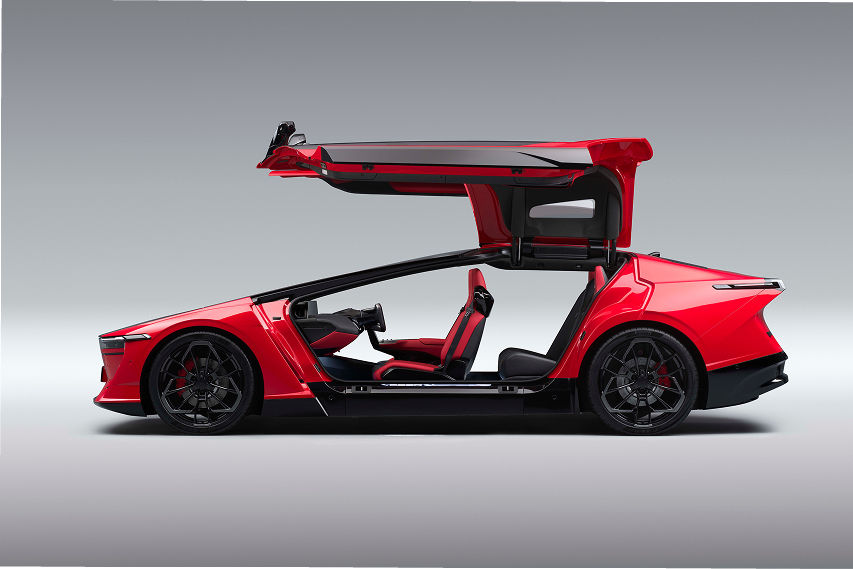 Photo from CEER
Some of the details are more specific. The lighting incorporates 32 bars as a reference to 1932, the year Saudi Arabia was unified, while the forged aluminium wheels use triangular patterns inspired by traditional architectural openings.
Then there are the Shahin Wing Doors. Named after the Shahin falcon, each is nearly three metres long and provides access to both the front and rear seats. They can be operated through the key fob or controls on the doors, with CEER quoting a 60 cm opening arc.
The windscreen is another talking point. CEER claims its 2.4-metre-long glass is the largest ever produced, with a quoted inclination of 15 degrees. Reflective coatings are intended to limit heat entering the cabin, which is a fairly important consideration for a car developed for Saudi Arabia.
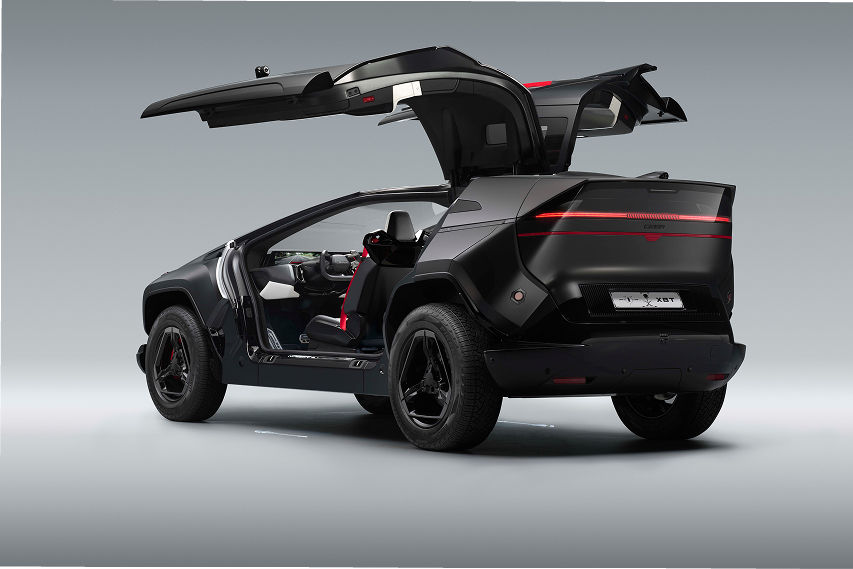 Photo from CEER
Up to 1,111 hp, but the First Edition gets 850 hp
The EXOBOT uses a three-motor, all-wheel-drive electric powertrain, supported by torque vectoring and active chassis systems.
At the highest specification, CEER quotes 1,111 hp and 1,500 Nm. That gives the sedan a claimed 0–100 km/h time of 2.1 seconds and a 250 km/h top speed. The SUV takes 2.4 seconds and tops out at 210 km/h.
Those figures should not be confused with the launch First Edition models, which produce 850 hp and 1,000 Nm. Their claimed sprint times are 2.6 seconds for the sedan and 2.9 seconds for the SUV.
Either way, outright acceleration is unlikely to be something owners find lacking.
The steering setup is unusual too. A steer-by-wire system removes the conventional steering column, while a compact steering yoke replaces the usual wheel. Rear-wheel steering is also fitted to help manoeuvrability at low speeds and stability at higher speeds.
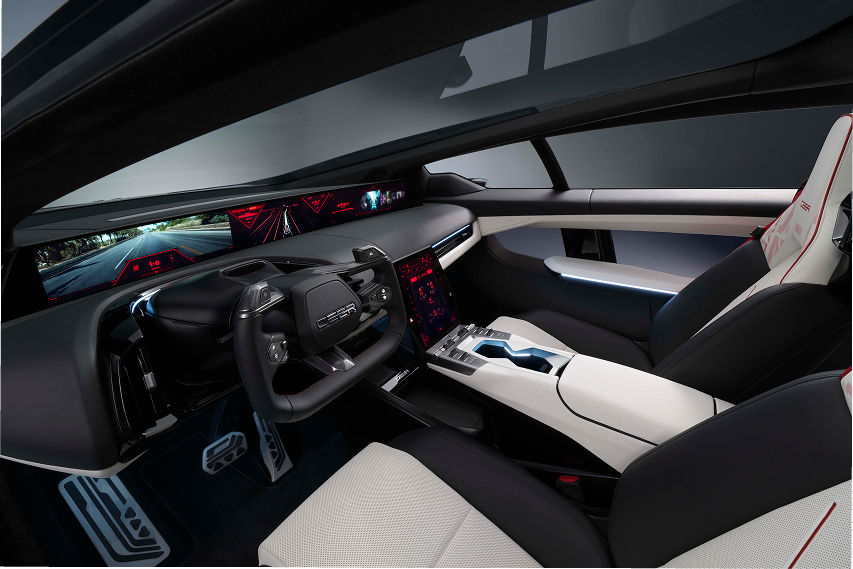 Photo from CEER
First Edition: 112 kWh battery and up to 670 km of range
Both First Edition body styles receive a 112 kWh battery and an 800V electrical architecture.
CEER quotes up to 670 km of range for the sedan and 560 km for the SUV. However, the supplied announcement does not identify the testing standard behind those figures, so direct comparisons with WLTP-rated EVs would be premature.
Charging from 10–80% is claimed to take under 30 minutes, although the release does not state the peak charging power or the conditions needed to achieve that time.
The First Edition also brings red brake calipers, a Black Color Pack and black-and-red Nappa leather upholstery. There are First Edition markings on the headrests, bespoke floor mats and a numbered plaque linked to each vehicle’s VIN.
Exterior colour choices are Harrat Grey and White Musk. CEER describes the First Edition as limited, but does not give a production number in the announcement. An EXOBOT PLUS version will follow.
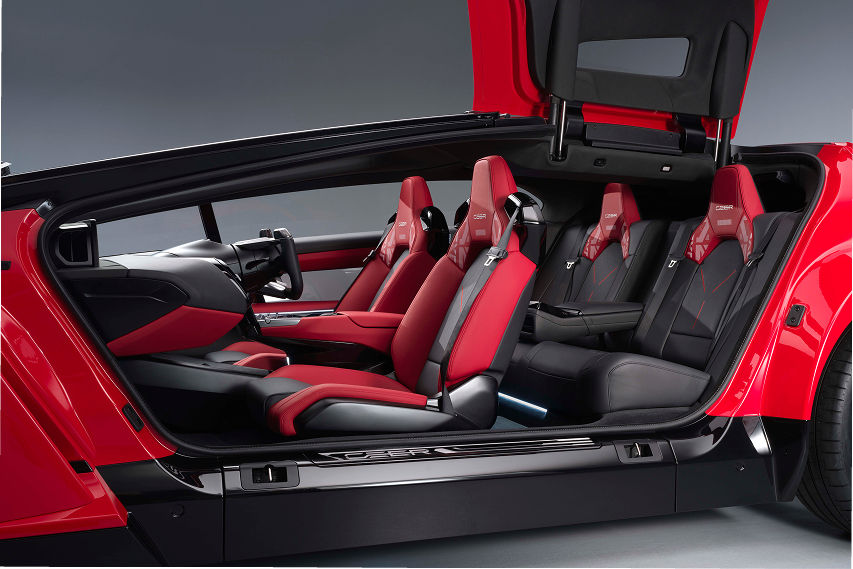 Photo from CEER
Cooling gets as much attention as the screens
A large glass area and Saudi sunshine could make for an uncomfortable combination, so CEER has put considerable emphasis on cabin cooling.
Its system, called Halo Cooling, combines front and rear air-conditioning units with heat-reducing glazing and measures intended to limit heat build-up around the roof.
According to CEER, it can bring cabin temperature down from 65°C to 32°C in 10 minutes in high-heat conditions. That is a useful indication of its cooling capability, although 32°C is still warm and the claim will need to be judged in everyday use.
The lower door glass can also switch between tinted and opaque settings at the touch of a button, giving occupants some control over visibility and privacy.
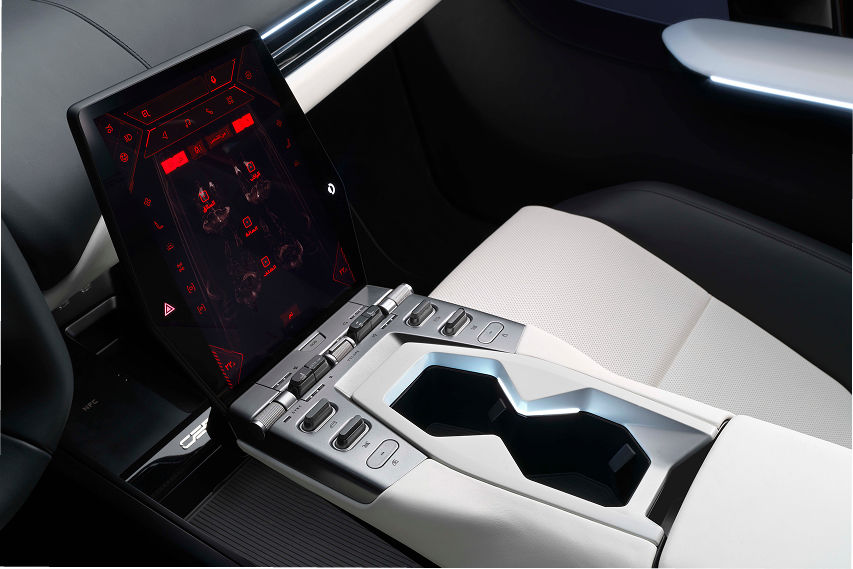 Photo from CEER
A 48-inch display, with physical controls retained
Across the dashboard sits a 48-inch curved display with 8K resolution, joined by a 10.4-inch central control screen and an 8-inch display for rear passengers.
Despite all that screen space, CEER has retained physical controls for functions including gear selection, climate settings and audio volume.
An Arabic- and English-speaking voice assistant is included, while the CEER app provides access to charging information, cabin pre-conditioning and remote parking. Digital-key access with smartwatch integration is also planned.
The audio system uses exciters to turn cabin surfaces into sound-producing elements, working alongside dedicated audio components. There is even a fragrance system that accommodates three scents at a time.
Over-the-air updates are intended to add features and update vehicle software after delivery.
CEER lists seven airbags, an aluminium body structure using castings and extrusions, and cell-to-pack battery construction among the EXOBOT’s safety features.
It also describes hands-free driving support, automated lane changes and navigation-based highway driving assistance.
However, the announcement does not specify the automation level, operating restrictions or driver-monitoring requirements. Those details are needed to establish exactly what the systems can do and how much supervision they require.
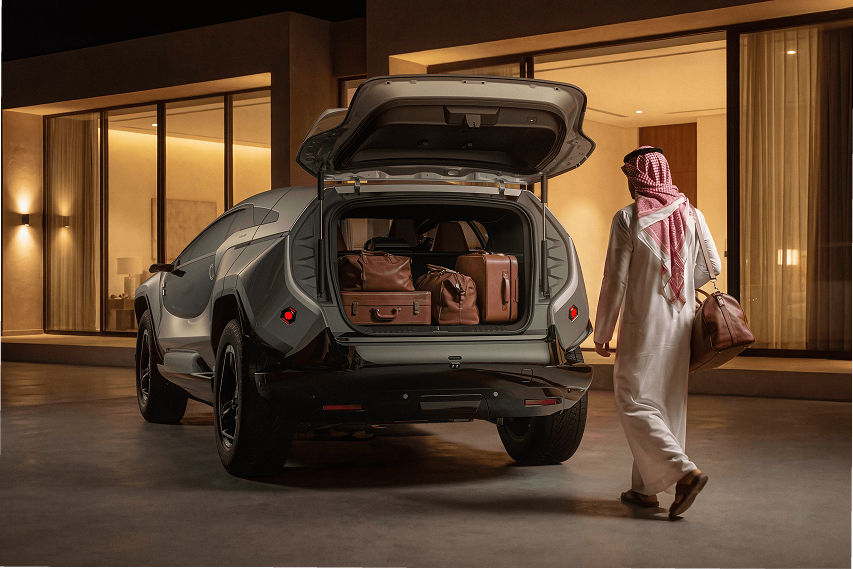 Photo from CEER
Built in Saudi Arabia, with seven models planned
The EXOBOT sedan and SUV will be manufactured at the CEER Manufacturing Complex in King Abdullah Economic City, Saudi Arabia.
CEER is targeting 45% local material content by 2034 and says local production should help shorten delivery times and support parts availability. Its ambition is to fulfil orders within weeks rather than months, although that remains a target.
The EXOBOT pair gives the new brand a conspicuous starting point. The doors and acceleration figures will attract attention, but pricing, real-world range, reliability and aftersales support will determine how convincing the ownership proposition is.
The supplied announcement does not include prices or any plans for a Malaysian launch.

KLIMS 2026


Malaysia Autoshow
Trending & Fresh Updates
- Latest
- Popular
-

-
-
-
-
-
-
-
-
-
Electric Car: A comprehensive buying guidePurva Jain, Jul 01, 2024
-
Must watch automotive movies for enthusiastsPurva Jain, Feb 21, 2024
-
Car Rust-proofing 101: All you need to knowPurva Jain, Feb 15, 2024




You might also be interested in
- News
- Featured Stories

Featured Cars
- Latest
- Upcoming
- Popular
-
 Hyundai StargazerRM 99,800 - 121,800 OTR Price Kuala LumpurEMI : RM 1,165 x 84Write a Review VIEW SEPTEMBER OFFERS
 -
Jetour T2 i-DMRM 162,800 OTR Price Kuala LumpurEMI : RM 1,902 x 84Write a Review VIEW SEPTEMBER OFFERS
-
Volvo EX30RM 198,888 - 218,888 OTR Price Kuala LumpurEMI : RM 2,324 x 844.33 (9 Reviews) VIEW SEPTEMBER OFFERS
-
JAECOO J5 EVRM 118,800 OTR Price Kuala LumpurEMI : RM 1,387 x 84Write a Review VIEW SEPTEMBER OFFERS
-
Honda WR-VRM 94,900 - 104,900 OTR Price Kuala LumpurEMI : RM 1,108 x 843.95 (20 Reviews) VIEW SEPTEMBER OFFERS
-
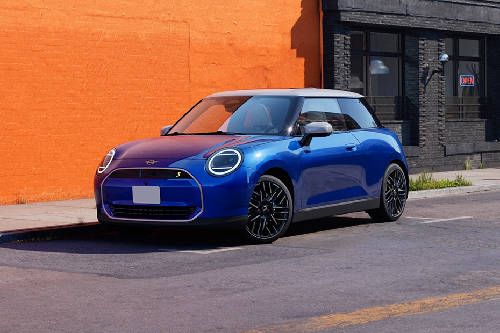
MINI ElectricRM 193,888 - 218,888 OTR Price Kuala LumpurEMI : RM 2,265 x 844.33 (15 Reviews) VIEW SEPTEMBER OFFERS
-
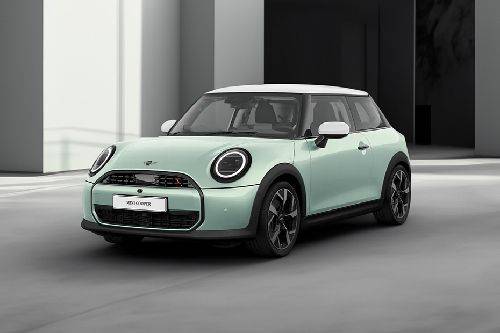
MINI 3 DoorRM 193,888 - 318,888 OTR Price Kuala LumpurEMI : RM 2,265 x 844.38 (26 Reviews) VIEW SEPTEMBER OFFERS
-
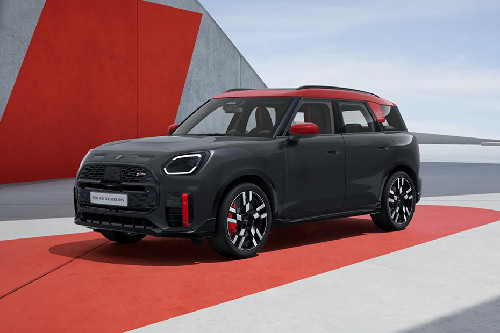
MINI John Cooper WorksRM 218,888 - 393,888 OTR Price Kuala LumpurEMI : RM 2,557 x 844.38 (13 Reviews) VIEW SEPTEMBER OFFERS
-
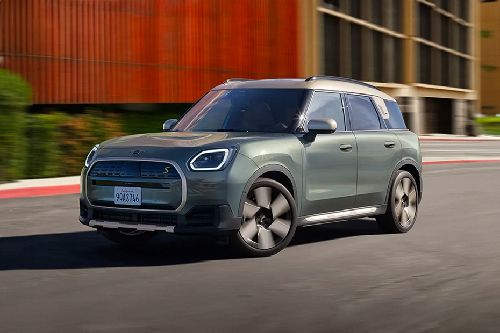
MINI Countryman ElectricRM 258,888 By Order Kuala LumpurEMI : RM 3,025 x 844.11 (8 Reviews) VIEW SEPTEMBER OFFERS
-
Perodua BezzaRM 34,580 - 49,980 OTR Price Kuala LumpurEMI : RM 404 x 844.19 (81 Reviews) VIEW SEPTEMBER OFFERS
Latest Car Videos on Zigwheels

-
Chery Tiggo 9 Review Malaysia – Is This the Best-Value 7-Seater AWD SUV?25 Aug, 2026 .
-
Jetour T1 1.5L: Tak laju, tapi tu bukan point dia | review Malaysia14 Aug, 2026 .
-
Proton e.MAS 7 PHEV Premium — the smartest car buy in Malaysia right now?25 Jun, 2026 .
-
Leapmotor B10 KL to Penang, Is This Sub-RM120k EV Enough for Everyone?11 May, 2026 .
-
First Drive GWM WEY G9, MPV Premium Paling Berbaloi Sekarang?11 May, 2026 .
-
2026 BMW i5 CKD Review Malaysia - Has BMW Built the EV for People Still Not Sold on EVs?10 Apr, 2026 .
-
Mitsubishi Xforce First Impressions Malaysia – Is This the Surprise SUV of 2026?24 Mar, 2026 .
-
2026 Perodua Traz Review – Is It Worth a Try?04 Feb, 2026 .
-
1 Tank, 3 Days, 1,200 KM… The Chery Tiggo 7 PHEV Actually Did It10 Dec, 2025 .
-
The Jaecoo J8 Might Be the Best SUV Under RM200k… Here’s Why!10 Dec, 2025 .