Old BMW EV and PHEV batteries could soon power rural homes in Malaysia
KUALA LUMPUR: BMW Group Malaysia and Universiti Malaya are exploring how retired electric vehicle batteries can be repurposed into energy storage systems for rural electrification, giving batteries that are no longer suitable for cars a second life in communities that still depend on diesel generators for electricity.
The collaboration was highlighted during a media awareness session at Universiti Malaya, where researchers explained how end-of-life EV batteries can still hold value beyond their first use in a vehicle. Instead of sending retired batteries straight for recycling, the project looks at how their remaining usable capacity can be turned into practical storage for solar-powered rural homes.
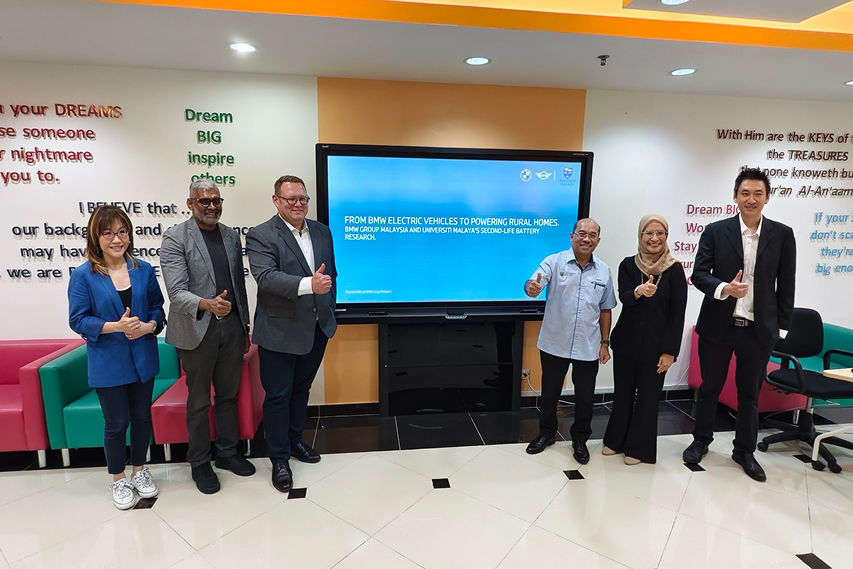 Photo by Adam Aubrey
Also Read: BMW Group Malaysia partners with Universiti Malaya to repurpose used EV batteries
The idea is simple. An EV battery may no longer meet the demanding requirements of automotive use, where range, performance, charging behaviour and safety margins are critical. However, that does not mean the battery is dead. In a less demanding stationary role, the same battery can still store energy and supply power for basic household needs.
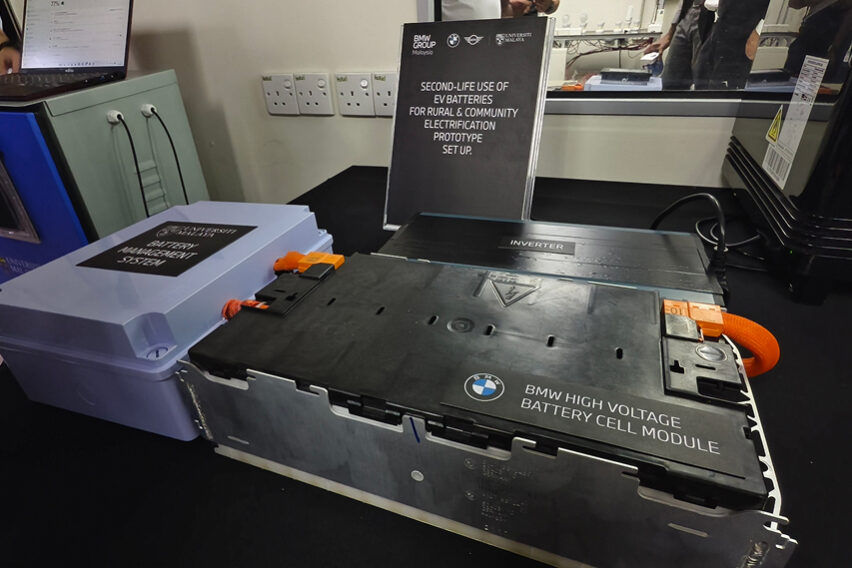
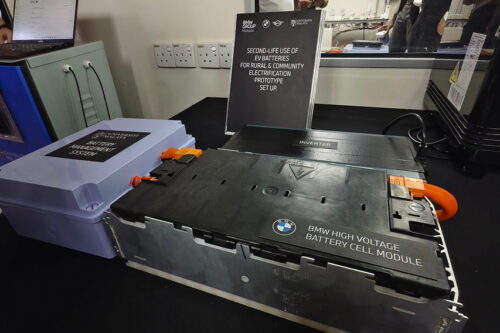
BMW Malaysia used a Gen 4 battery module as a simple reference point during the session, noting that one module can power a regular urban home for up to 12 hours. That figure was not presented as the main use case, but as a way to understand the potential of a single module. The bigger question is what that same technology could do for rural households where electricity may still come from diesel generators, often for only a few hours a day.
In BMW electrified models sold in Malaysia, from plug-in hybrids such as the 330e and 530e to full EVs such as the iX, i4, i5 and i7, the high-voltage battery pack is made up of multiple modules. The exact number varies depending on model, battery size and generation, but the point of the Universiti Malaya project is that even individual retired modules can still be graded, tested and repurposed for stationary energy storage.
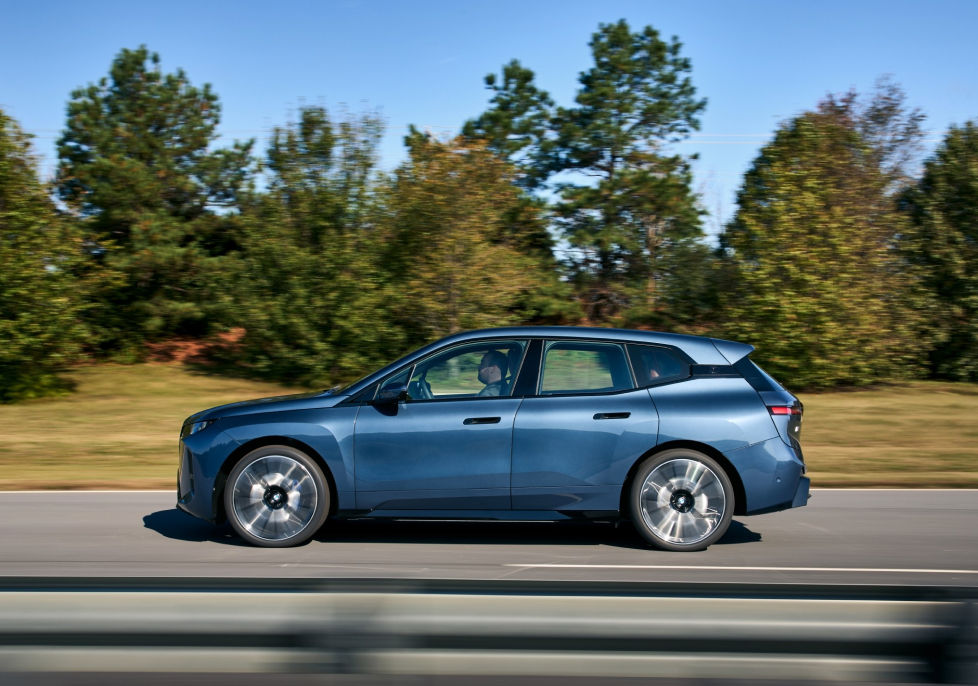 Photo from BMW
Universiti Malaya’s research focuses on matching end-of-life battery capacity with real-world second-life application needs. One example shown during the presentation involved a second-life battery unit with a usable capacity of 1.6 kWh, matched against a sample daily household energy consumption of 1.632 kWh. The projected load included basic household items such as fans, lights, a TV, a refrigerator and a rice cooker.
Based on UMPEDAC’s testing, newer-generation BMW batteries average around 1.6 kWh per pack, while older-generation units average around 0.5 kWh. Higher-capacity packs are being directed towards heavier rural electrification use, while lower-capacity packs can still be used for lighter applications.
That makes the project easier to understand. This is not about powering a high-consumption modern household filled with large appliances. It is about basic electricity, lights at night, fans, refrigeration, cooking support and small everyday items that many urban users take for granted.
The rural electrification angle was a central part of the presentation. Universiti Malaya highlighted that electrification of rural communities remains a challenge, especially in areas located far from cities. The slides also pointed out that many solar systems in rural areas have been abandoned as early as three to four years after project completion. The reasons were traced to limited maintenance funds and a lack of knowledge to properly upkeep the systems.
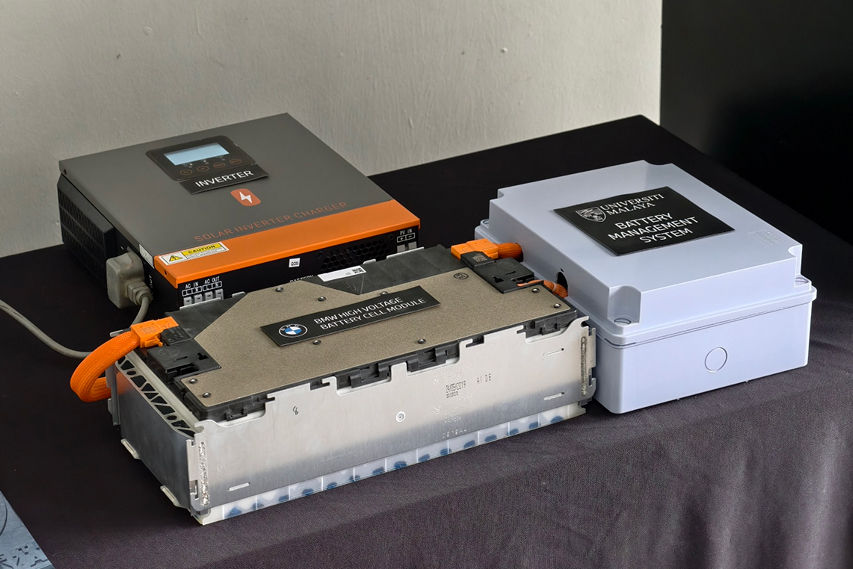 Photo by Adam Aubrey
That is where the project goes beyond simply installing equipment. Universiti Malaya described its rural electrification objectives using the “3Es”, Empower, Electrify and Educate. The aim is to equip rural communities with basic electrical supply through solar systems, while also giving them the knowledge and skills to operate and maintain the equipment. The education component also covers the cost and environmental benefits of solar power.
This is an important distinction because rural energy projects can fail when systems are installed and then left behind. For second-life EV batteries and solar systems to work in the long term, the community must be able to understand, operate and maintain the setup. Otherwise, the same problem repeats itself, a system is donated, it works for a while, then it becomes another abandoned project once something fails.
The cost comparison is where the rural electrification angle becomes more tangible. According to Universiti Malaya’s slides, electricity from a diesel generator can cost around RM10 for roughly three hours of use. Another example stated that a household could spend around RM300 per month just to run lights for three hours per night.
On top of that, the slides also highlighted the problem of non-continuous supply, including intermittent refrigerator use for food preservation. In that context, solar-battery storage is not just a cleaner alternative, it could reduce dependence on expensive diesel-generated electricity.
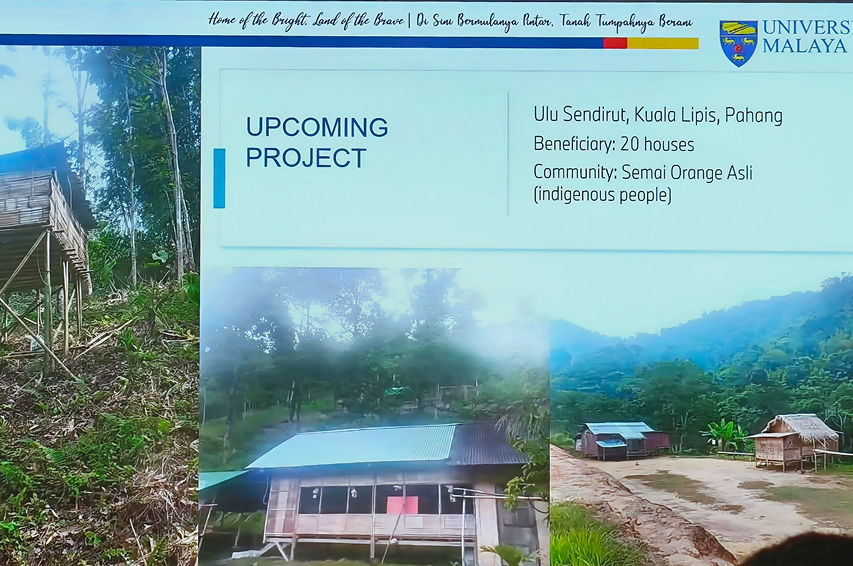 Photo by Adam Aubrey
An upcoming BMW Malaysia x University Malaya project mentioned during the session is located in Ulu Sendirut, Kuala Lipis, Pahang. The project is expected to benefit 20 houses within a Semai Orang Asli community.
The end goal is the deployment of standalone energy storage units to a rural Malaysian village, with refrigeration identified as a critical application. For families who hunt or gather food, access to refrigeration can reduce spoilage and allow meat and other perishables to be stored safely instead of consumed or distributed immediately.
The technical process behind the second-life battery system is also more involved than simply removing a battery from a vehicle and plugging it into a house.
Universiti Malaya’s Associate Professor Dr. Tan Chia Kwang showed a repurposing workflow that begins with end-of-life EV battery grading tests and capacity determination. The batteries are then sorted, configured into a suitable pack topology, assembled into a second-life battery pack and validated with a Battery Management System, or BMS.
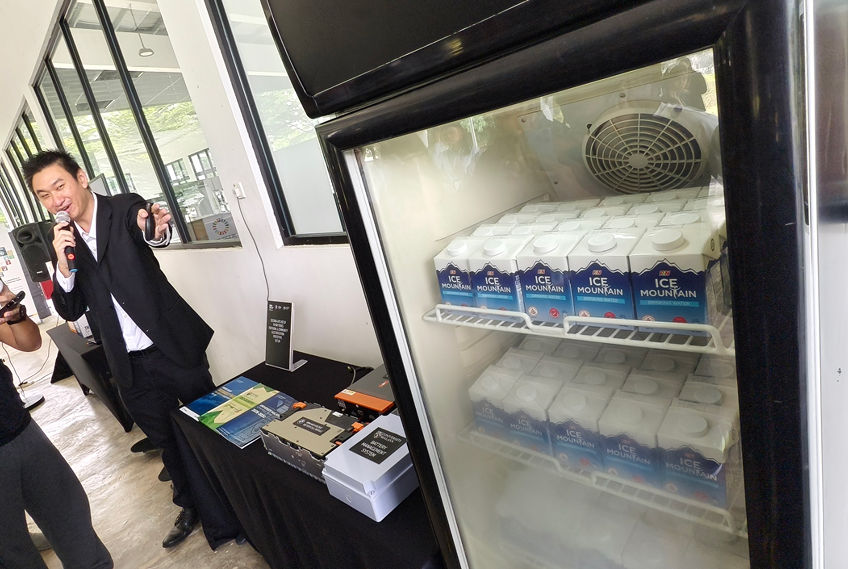 Photo by Adam Aubrey
The BMS is a key part of the system because it manages charging, discharging, output and communication with other components. In the solar-battery setup shown, the second-life battery system works together with solar panels, a solar charge controller, charger inverter, energy meter and control systems.
Under best-case conditions, the repurposed battery system could last up to 20 years in its second-life role. That figure will depend on battery health, usage pattern, charging behaviour, temperature, system design and maintenance, but it shows why second-life applications are worth studying. If a retired EV battery can continue serving as stationary storage for many more years before final recycling, its total useful lifespan becomes much longer than its first life in a vehicle.
For BMW Group Malaysia, the project also connects with its wider circular economy efforts under the RE:GENERATE initiative. The company highlighted that sustainability is not limited to electric mobility alone, but extends across the vehicle life cycle, from how materials are sourced to what happens at the end of a vehicle’s life.
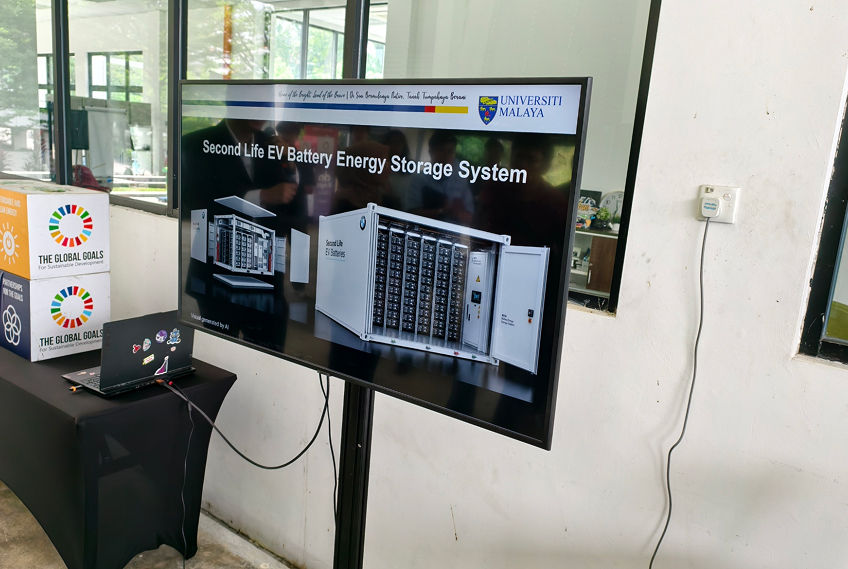 Photo by Adam Aubrey
As of March 2025, BMW Group Malaysia had delivered over 38,700 electrified vehicles in Malaysia, covering fully electric and plug-in hybrid models, while over 13,600 batteries had been recollected as part of its standard practice.
The wider national challenge is also coming into view. The presentation cited a projection that by 2050, around 870,000 EV batteries in Malaysia will need recycling. That makes second-life applications more than a sustainability showcase. They could become a practical middle step between first use in a vehicle and final recycling.
For now, the BMW Malaysia and Universiti Malaya collaboration shows that retired EV batteries still have useful life beyond the car. If the technology can be safely scaled, it could help reduce battery waste, support cleaner rural electrification and offer a more practical electricity solution for communities that still pay heavily for a few hours of diesel-generated power.
Also Read: BMW Malaysia launches two new models - X3 30 xDrive M Sport and long-wheelbase iX1 EV

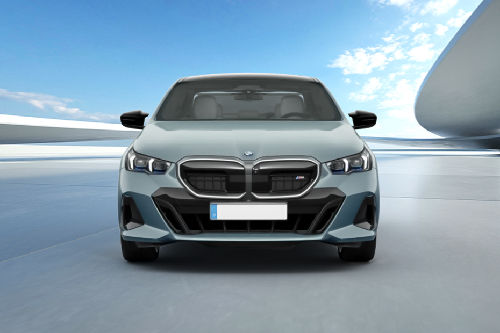
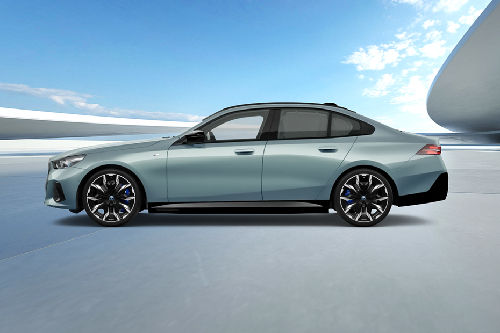
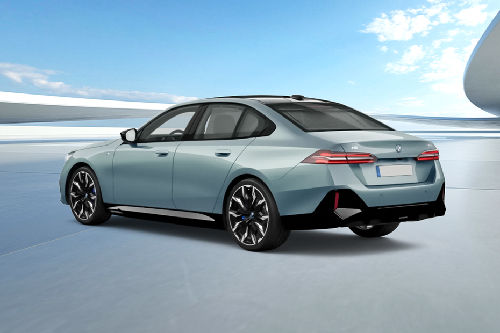
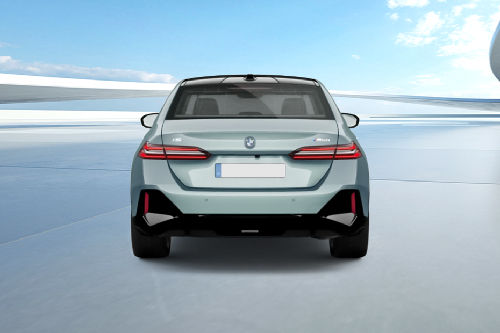
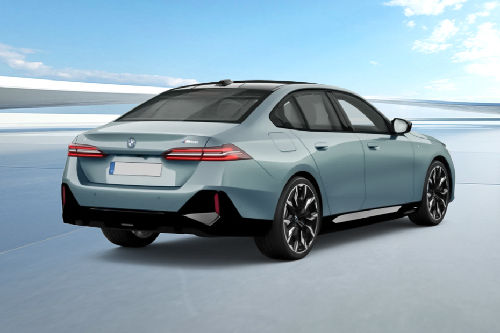
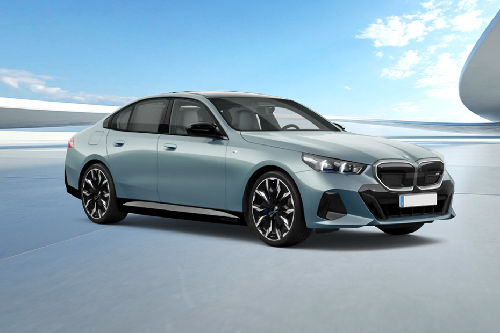
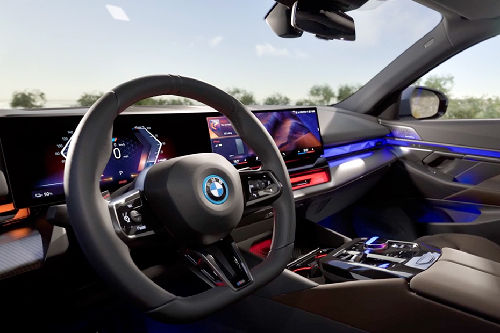
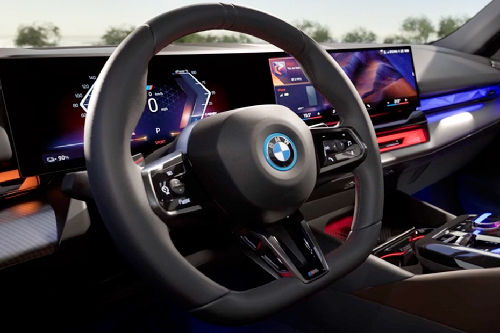
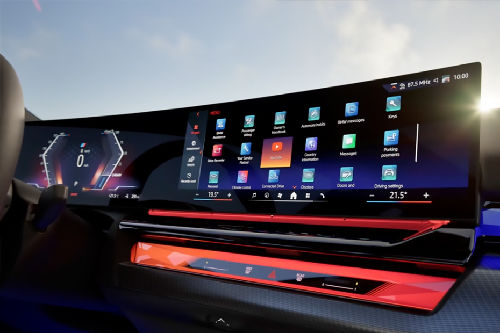
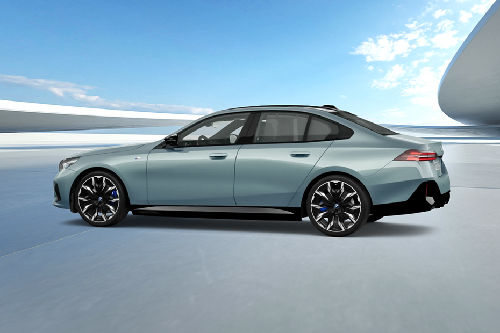
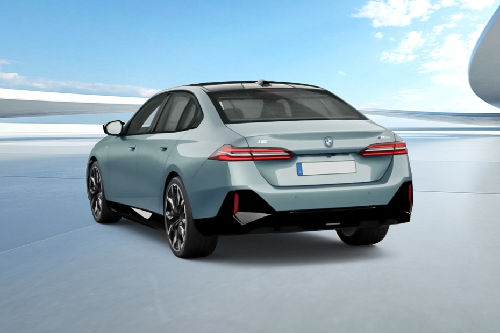
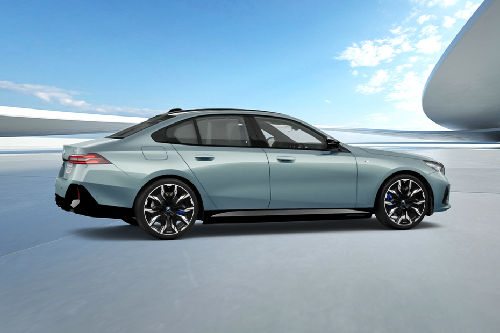
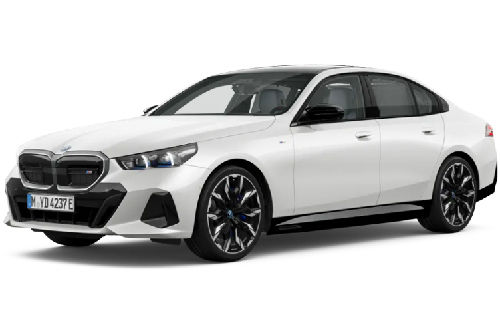
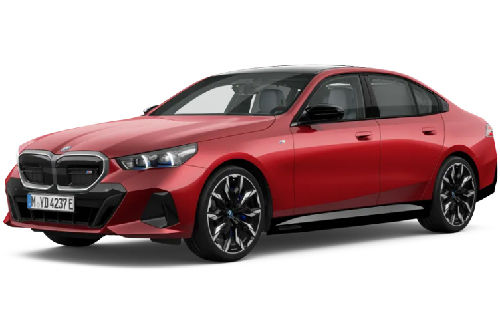
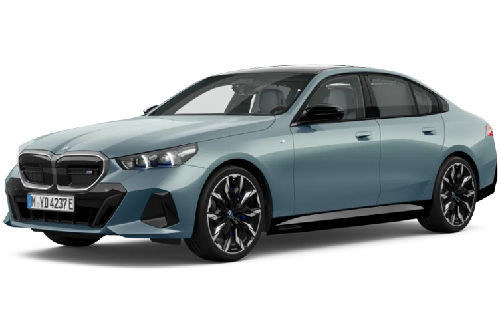
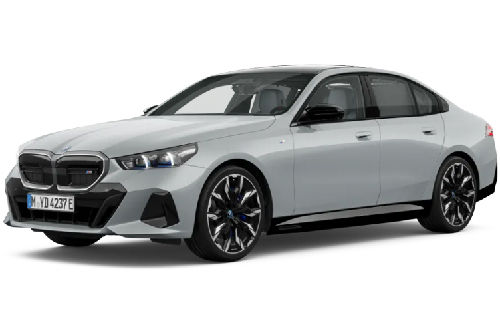
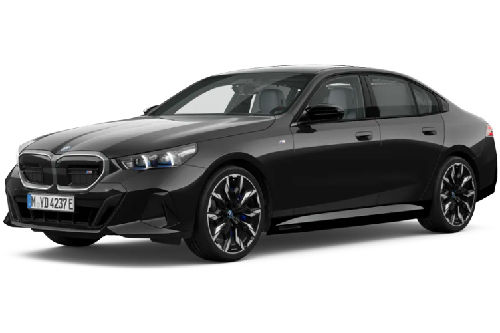

BMW i5 Related Stories
- News
- Expert Review
-
 BMW i5 eDrive40 M Sport Pro Now CKD in Malaysia, First Locally Assembled BMW EV From RM368,800
KUALA LUMPUR: BMW Group Malaysia has introduced the locally assembled BMW i5 eDrive40 M Sport Pro, a big milestone because...
Read MoreAdam Aubrey, Jan 15, 2026 -
BMW Malaysia becomes official E-Mobility Partner for Maybank Championship 2025
KUALA LUMPUR: BMW Malaysia is committed to sustainability and promoting eco-friendly mobility solutions in the country. In line with this...
Read MoreSippi Vig, Oct 28, 2025 -
BMW i7 and i5 support Malaysia’s green Initiatives during ASEAN 2025
KUALA LUMPUR: Malaysia has been leading the ASEAN group of nations in 2025 as the Chair, promoting sustainability and collaborative...
Read MoreSippi Vig, Oct 16, 2025
-
Review: BMW i5 eDrive40 M Sport Pro CKD - Not just another fast appliance
What exactly is a premium EV supposed to feel like? Because the answer, at least in 2026, still isn’t as...
Read MoreAdam Aubrey, Apr 06, 2026 -
Review: 2024 BMW i5 eDrive40 M Sport - The EV that drives like a true BMW, the ultimate driver's EV?
With the influx of Chinese EVs this year, it’s easy to get swept up in the buzz of value-for-money electric...
Read MoreAdam Aubrey, Aug 30, 2024
BMW Car Models
-

BMW X1 -
BMW 3 Series Sedan -
BMW X3 -
BMW 5 Series Sedan -
BMW 2 Series Gran Coupe -
BMW X4 -
BMW iX1 -
BMW iX2 -
BMW X7 -
BMW iX
Don't Miss
-
Mercedes-Benz electric C-Class revealed, 10 things you need to know
-
BMW i5 eDrive40 M Sport Pro Now CKD in Malaysia, First Locally Assembled BMW EV From RM368,800
-
Volvo Car Malaysia extends free data connectivity for MY22 and MY23 owners
-
BMW Malaysia becomes official E-Mobility Partner for Maybank Championship 2025
Malaysia Autoshow


Trending & Fresh Updates
- Latest
- Popular
-

-
-
-
-
-
-
-
-
-
Electric Car: A comprehensive buying guidePurva Jain, Jul 01, 2024
-
Must watch automotive movies for enthusiastsPurva Jain, Feb 21, 2024
-
Car Rust-proofing 101: All you need to knowPurva Jain, Feb 15, 2024


You might also be interested in
- News
- Featured Stories
-
-
-
-
-
-
Volvo ES90: Detailed in 22 picsSippi Vig, Jan 28, 2026
BMW Featured Cars
- Latest
- Upcoming
- Popular
-
BMW iX1RM 250,800 - 275,800 OTR Price Kuala LumpurEMI : RM 2,930 x 844.09 (11 Reviews) VIEW MAY OFFERS
-
BMW iXRM 425,800 - 487,800 OTR Price Kuala LumpurEMI : RM 4,975 x 844.64 (22 Reviews) VIEW MAY OFFERS
-
BMW X5RM 469,800 - 494,800 OTR Price Kuala LumpurEMI : RM 5,489 x 844.52 (23 Reviews) VIEW MAY OFFERS
-
BMW M5RM 1.19 Million OTR Price Kuala LumpurEMI : RM 13,892 x 844.48 (23 Reviews) VIEW MAY OFFERS
-
BMW 3 Series SedanRM 265,800 - 388,800 OTR Price Kuala LumpurEMI : RM 3,105 x 844.38 (26 Reviews) VIEW MAY OFFERS
-
BMW M3 CompetitionRM 720,990 - 838,800 OTR Price Kuala LumpurEMI : RM 8,426 x 844.57 (21 Reviews) VIEW MAY OFFERS
-
BMW 5 Series SedanRM 332,800 - 349,800 OTR Price Kuala LumpurExpected Launch TBA Alert Me When Launched
-
-
BMW 3 Series SedanRM 265,800 - 388,800 OTR Price Kuala LumpurEMI : RM 3,105 x 844.38 (26 Reviews) VIEW MAY OFFERS
-
BMW X3RM 304,800 - 357,800 OTR Price Kuala LumpurEMI : RM 3,561 x 844.36 (25 Reviews) VIEW MAY OFFERS
-
BMW 5 Series SedanRM 332,800 - 349,800 OTR Price Kuala LumpurEMI : RM 3,888 x 844.56 (25 Reviews) VIEW MAY OFFERS
-
BMW 2 Series Gran CoupeRM 218,800 OTR Price Kuala LumpurEMI : RM 2,556 x 844.42 (31 Reviews) VIEW MAY OFFERS
-
Latest BMW i5 Car Videos on Zigwheels

-
2026 BMW i5 CKD Review Malaysia - Has BMW Built the EV for People Still Not Sold on EVs?10 Apr, 2026 .
-
BMW i5 REALLY the Best EV for City Driving? Let's find out15 Oct, 2024 .

Compare & Recommended
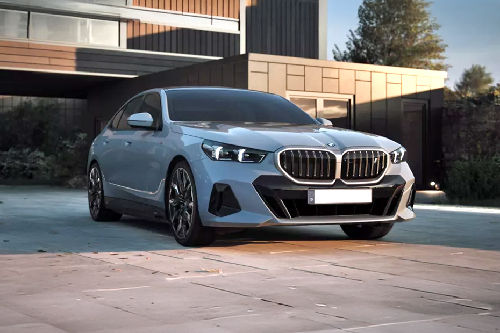
BMW i5
RM 368,800 - 479,800
BMW i5 Price
|
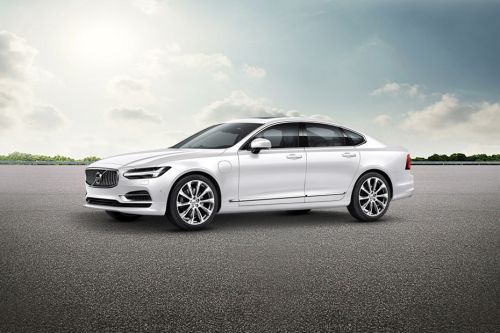
|
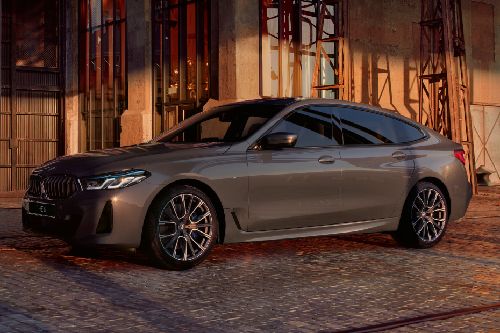
|
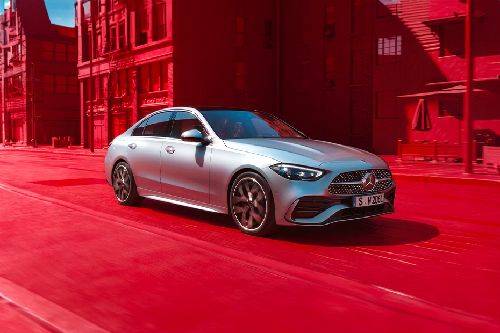
|
|
|
Seating Capacity
5
|
5
|
5
|
5
|
5
|
|
Fuel Type
Electric
|
Petrol
|
Petrol
|
Petrol
|
Petrol
|
|
Power
340
|
320
|
258
|
204
|
407
|
|
Torque
430 Nm
|
400 Nm
|
400 Nm
|
300 Nm
|
640 Nm
|
|
Transmission Type
Automatic
|
Automatic
|
Automatic
|
Automatic
|
Automatic
|
|
Engine
-
|
1969
|
1998
|
1496
|
1969
|
|
|
Trending Sedan
- Latest
- Upcoming
- Popular
-
Tesla Model Y LRM 260,000 OTR Price Kuala LumpurEMI : RM 3,038 x 84Write a Review VIEW MAY OFFERS
-
Dongfeng 007RM 169,888 - 195,888 OTR Price Kuala LumpurEMI : RM 1,985 x 84Write a Review VIEW MAY OFFERS
-
-
Toyota Vios HEV GR SportRM 109,900 Expected Price Kuala LumpurEMI : RM 1,284 x 84Write a Review VIEW MAY OFFERS
-
Toyota Vios Hybrid ElectricRM 103,900 Expected Price Kuala LumpurEMI : RM 1,213 x 84Write a Review VIEW MAY OFFERS
-
Mercedes Benz Maybach S-ClassRM 1.99 - 2.4 Million OTR Price Kuala LumpurEMI : RM 23,266 x 844.7 (10 Reviews) VIEW MAY OFFERS
-
-
-
-
BMW 5 Series SedanRM 332,800 - 349,800 OTR Price Kuala LumpurExpected Launch TBA Alert Me When Launched
-
-
-
Perodua BezzaRM 34,580 - 49,980 OTR Price Kuala LumpurEMI : RM 404 x 844.19 (81 Reviews) VIEW MAY OFFERS
-
Honda CityRM 84,900 - 111,900 OTR Price Kuala LumpurEMI : RM 991 x 844.23 (70 Reviews) VIEW MAY OFFERS
-
Toyota ViosRM 89,600 - 95,500 OTR Price Kuala LumpurEMI : RM 1,047 x 844.17 (71 Reviews) VIEW MAY OFFERS
-
Proton S70RM 68,800 - 89,800 OTR Price Kuala LumpurEMI : RM 803 x 843.97 (30 Reviews) VIEW MAY OFFERS
-
Nissan AlmeraRM 83,888 - 95,888 OTR Price Kuala LumpurEMI : RM 980 x 844.13 (56 Reviews) VIEW MAY OFFERS
-
Proton PersonaRM 47,800 - 58,300 OTR Price Kuala LumpurEMI : RM 558 x 844.15 (75 Reviews) VIEW MAY OFFERS